Perfectly furnished yet still personal: A home doesn’t have to be overdecorated or deliberately imperfect to show character. Interior designer Stefanie Winter explains why favorite pieces, materials, and bold choices are more important than trends—and why a well-designed home doesn’t have to be completely finished.
Flawless sofa arrangements, perfectly arranged coffee-table books, and that lamp that seems to pop up in every other interior design feed: Inspiration is everywhere these days. The problem begins when inspiration turns into interchangeability. Because no matter how beautifully furnished a home may be—if nothing tells a story about the people who live there, it remains nothing more than a pretty backdrop.
Interior designer Stefanie Winter has absolutely nothing against perfection. Quite the opposite. “I love it when the proportions are just right, the colors work well together, and you can tell there’s a concept behind a room,” she says.
How can an apartment gain more personality instead of looking like something out of a catalog?
For Winter, personality doesn’t mean cramming as many things as possible into a room or deliberately avoiding the “perfect” look. “It comes from decisions that have to do with the people who live there.”
It could be a painting you’ve had hanging on your wall for years, an old armchair, a book collection, or an heirloom. Maybe it’s a color you’ve always loved—or a piece of furniture that not everyone would choose. “I think you should be able to look at a room and eventually think: This is exactly where these people live.”
And that’s a crucial difference from a perfectly copied interior design template: a personal space simply couldn’t belong to anyone else quite as well.
What defines spaces with character?
Doesn’t that mean a little imperfection has to find its way into the home? Not necessarily, Winter believes. “For me, rooms can certainly be perfect.” She just defines perfection differently: not as a state where everything is new, comes from the same collection, or matches a picture from a magazine as closely as possible. “I like rooms that are well thought out. I like order, structure, and a harmonious overall look. But within that framework, personality is allowed to shine through.”
Perhaps that’s actually the most beautiful form of perfection: “A room is beautifully designed and yet unmistakably unique.”
What kinds of furniture and home accessories make a home feel personal?
“Most of the time, it’s not the things you buy specifically for that purpose,” says Winter. “It’s the things that already have a story behind them.” This includes heirloom furniture, as well as art that means something to you, books that have actually been read, or a souvenir from a trip. Some things move from apartment to apartment over the years, and that’s precisely what gives them their value.
However, personality doesn’t always have to mean vintage. Even a new piece of furniture or an object can immediately say something about its owner. For Winter, one phrase is key: “That’s exactly who I am.”
How can old furniture be combined with modern interior design?
It’s precisely the interplay between old and new that can give a room that sense of excitement that completely newly furnished apartments sometimes lack. “When a client tells me, ‘But that has to stay,’ that’s often when it really gets interesting for me,” Winter explains. And yes, sometimes there are pieces where even she initially thinks, “Oh dear.”
But then the actual design process begins. Perhaps an old piece of furniture needs a different wall color, a very modern counterpart, or simply a calmer setting around it. “To me, old and new don’t have to be similar. It’s much more exciting when they work together.”
Then a piece of furniture that would look old-fashioned in the wrong setting can suddenly become the true focal point of a room: “It no longer looks old, but special.”
How much of a style mix can an apartment handle?
More than you might think. Winter considers rigid rules—such as limiting oneself to a maximum of two styles or a specific number of materials—to be of little help. “A lot, as long as there’s a connection,” is her answer to the question of the right mix of styles.
This connection can be created through colors, materials, recurring shapes, or a particular overall atmosphere. What’s more important is establishing a hierarchy within the space. “If every piece of furniture wants to be the star, things get complicated.”
Special things need space to make an impact. That’s why, for Winter, a successful interior design involves not only adding elements but also leaving some out. “For me, mixing styles works when, at some point, you no longer consciously notice the individual styles. You don’t see old, new, modern, or classic. You see a harmonious space.”
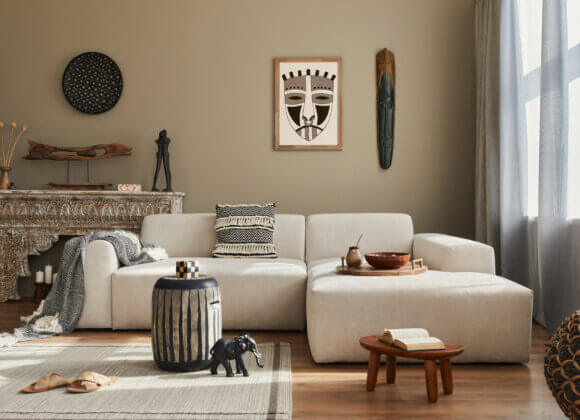
Rooms with Character: The perfect blend of styles gives your home a distinctive character.
What role do colors and materials play in creating a cozy home?
A much greater one than a few pillows or decorative accessories might suggest.
“Cozyness isn’t just created by decoration. It starts much earlier—with colors, surfaces, and materials,” explains Winter.
Wood creates a different atmosphere than high-gloss finishes; linen creates a different one than a smooth fabric; and a wool rug alters the feel of a room more significantly than many additional home accessories. Color, too, can convey a lot of personality—without having to paint an entire wall a spectacular shade of pink. “Sometimes it’s a very understated color palette that’s just right for a person.”
In fact, Winter is convinced: “Coziness can be planned.”
Why do expensive apartments sometimes still feel impersonal?
Because price and personality are two completely different categories. “I can fill a room with the most beautiful design classics and still fail to create an atmosphere,” says Winter. If you choose items based solely on what looks high-quality, trendy, or is generally recognized as “good design,” the person behind the interior can disappear. “That’s why, for me, a room needs both: quality and personality.”
A home shouldn’t feel like a list of well-known brands. “I don’t want to walk into a room and think, ‘Ah, I recognize that sofa, I recognize that lamp too, and I just saw that coffee table five times on Instagram.’” A different thought is much nicer: “It just fits here. And ideally, you don’t even notice why anymore.”
When is an apartment actually finished?
Ideally, never completely. Because while glossy photos capture a single perfect moment, real life is constantly changing. Children are born or move out, working from home suddenly becomes important, we discover new things while traveling, inherit furniture, buy art, or realize that something we loved ten years ago no longer suits us today.
“A home naturally changes along with us,” says Winter. That’s exactly why a good design concept must allow for change. “The foundation can be clear and well-thought-out, but there must still be room for life within it.”
Our Expert
Stefanie Winter is the owner of S.TEFANIE. interior.studio. For this Graz native, home is the visible expression of our personality. She designs spaces that bring clarity, tell stories, and help people feel truly at home. With a keen sense of color, materials, and atmosphere, she transforms houses and apartments into favorite places with character.
Warm, natural, and wonderfully imperfect: Travertine brings exactly the blend of tranquility and texture into the home that we long for in the fall. This natural stone is no longer reserved just for floors and bathrooms—today, it finds its way into the living room as vases, bowls, candleholders, or side tables. And it makes even …
Located right on Linken Wienzeile, this extraordinary residence is a stylish gem of a historic building with a view of one of Vienna’s liveliest neighborhoods. The Naschmarkt, Otto Wagner’s architecture, and the new Naschpark provide the backdrop for a home that uniquely blends Viennese tradition, an urban lifestyle, and international design. Spanning approximately 167 m² …
For many people, a good cup of coffee in the morning has long been a ritual. So why hide the machine, beans, and cups somewhere between the toaster and the paper towel roll? A coffee bar brings together everything you need for espresso, cappuccino, and other drinks in one place—and can even become a little …
SIE WOLLENNICHTSMEHR VERPASSEN?
Unser kostenloser Newsletter liefert Ihnen wöchentlich die neuesten Artikel rund ums Wohnen & Leben.
SIE WOLLENNICHTSMEHR VERPASSEN?
Unser kostenloser Newsletter liefert Ihnen wöchentlich die neuesten Artikel rund ums Wohnen & Leben.
SIE WOLLEN
NICHTS MEHR VERPASSEN?
Unser kostenloser Newsletter liefert Ihnen wöchentlich die neuesten Artikel rund ums Wohnen & Leben.